
What Becomes Valuable When AI Makes Game Prototyping Cheap?
AI can make game prototypes faster and cheaper. After 10K+ Reddit views, I looked at what developers think becomes more valuable as that happens.
Jump to sections
What Becomes Valuable When AI Makes Game Prototyping Cheap?
A little while ago, I asked game developers a question:
If AI makes game prototyping dramatically cheaper, what actually becomes more valuable?
The question came from watching the current wave of AI-assisted game creation tools.
We are moving toward a world where getting from an idea to something playable can happen increasingly quickly.
That sounds significant.
But it also raises a more interesting question.
If creating the first playable becomes easier, where does the difficult part of making a successful game move?
I posted the question on LinkedIn and Reddit.
The response was much more divided than I expected.
The Reddit discussions went past 10,000 views, while the original LinkedIn post generated another 8,000+ impressions, largely from people working in the games industry.
Some developers agreed with the premise.
Others strongly disagreed with it.
And one criticism in particular made me rethink how I would frame the question today.
“Prototyping Was Never Really the Bottleneck”
This was probably the fairest criticism I received.
Several developers essentially argued:
Making a prototype was never the hard part.
And they have a point.
Experienced developers have been building rough prototypes quickly for years.
Grey boxes, placeholder assets, hacked-together mechanics and ugly test scenes exist precisely because prototypes are supposed to answer questions cheaply.
The real problems usually arrive elsewhere.
Is the idea actually fun?
Does the mechanic stay interesting after ten minutes?
Can players understand it without the developer standing next to them?
Does the game have enough depth?
Can a team turn the prototype into a polished product?
Can anyone discover it?
Will players return?
Those problems aren't automatically solved because an AI tool can create a character controller, generate some art or assemble a playable scene.
So I would phrase my original argument differently now.
AI doesn't necessarily remove the prototyping bottleneck.
It may instead reduce the cost of certain steps between:
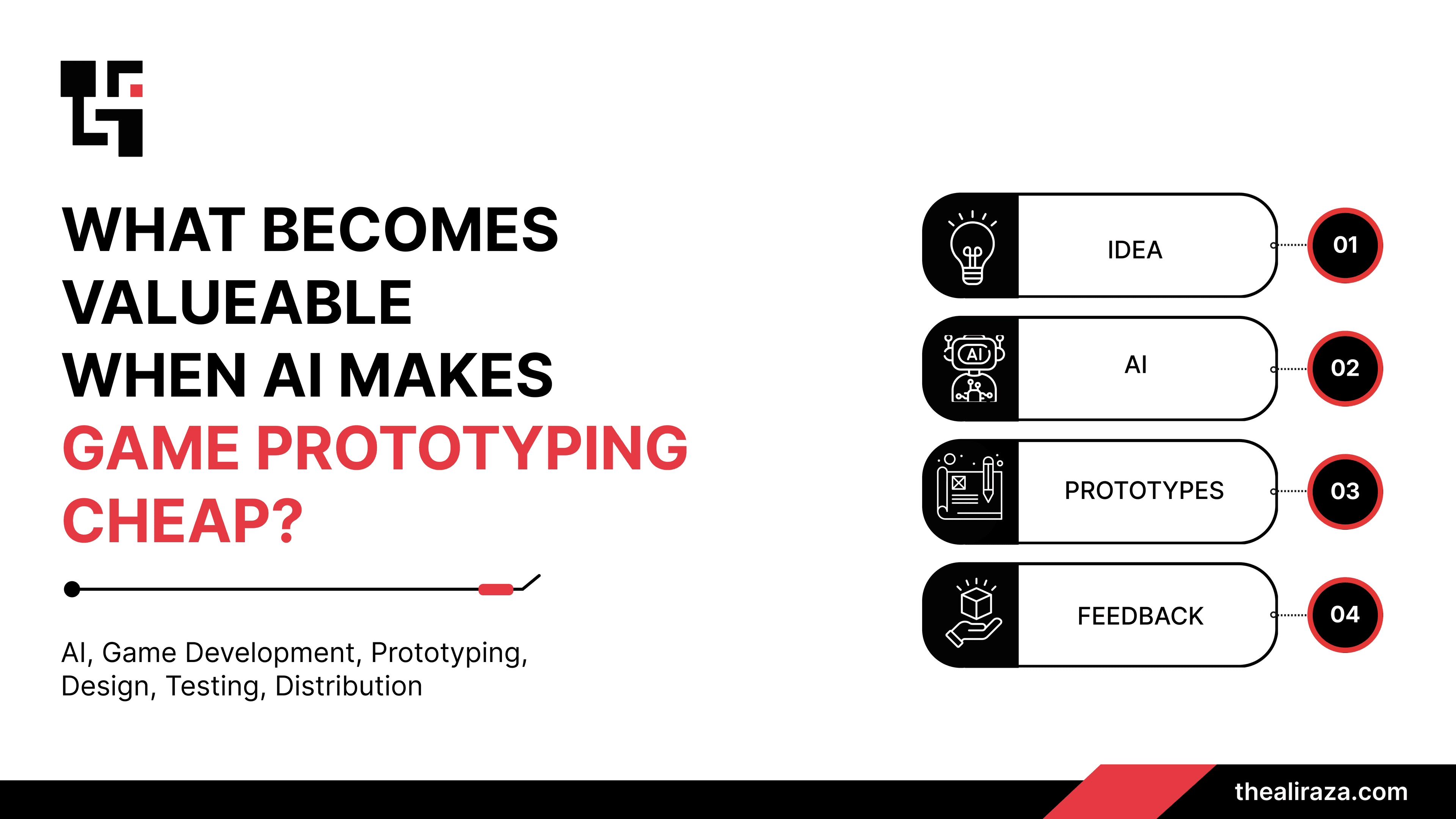
Idea → Rough Playable → Player Feedback
And that distinction matters.
1. Game Design Becomes More Important, Not Less
If implementing a mechanic becomes easier, deciding which mechanic deserves to be implemented becomes more valuable.
There is an enormous difference between:
“Make a platformer where the player can double jump.”
and:
“What combination of movement, level structure, challenge and progression will make someone want to play this for hours?”
The first problem is largely implementation.
The second is game design.
AI can potentially help with both, but generating possibilities is not the same as judging them.
A game can contain perfectly functional mechanics and still be boring.
It can look polished and still have no compelling loop.
It can technically work and still feel wrong.
That makes design judgment increasingly important.
2. Taste and Judgment Become a Bigger Differentiator
This came up repeatedly in the discussion.
When more people gain access to powerful creation tools, access to the tool itself stops being the differentiator.
What matters is what you do with it.
Two developers may have access to exactly the same AI models, game engines and asset libraries.
One produces something forgettable.
The other produces something players immediately understand and enjoy.
The difference is often taste.
Knowing:
- what to keep,
- what to remove,
- when something feels generic,
- when an interaction needs another iteration,
- when an idea isn't working,
- and when a prototype deserves further investment.
AI can create more options.
That arguably makes the ability to choose between those options even more important.
3. Real Player Testing Matters Even More
Developers are remarkably good at becoming blind to their own games.
We know what every button does.
We know where the player is supposed to go.
We understand the mechanic because we built it.
Then somebody completely unfamiliar with the project plays it and immediately does something we never expected.
That moment is incredibly valuable.
If AI reduces the cost of getting something playable, one of the best uses of that speed may simply be:
getting prototypes in front of real players earlier.
Instead of spending months polishing assumptions, we can potentially test some of those assumptions sooner.
Does the player understand the mechanic?
What do they try first?
Where do they become confused?
What do they ignore?
Where do they smile?
Where do they quit?
AI-generated prototypes aren't particularly valuable because they exist.
They're valuable when they help us learn something.
4. Iteration Still Separates Prototypes From Products
The first version is rarely the interesting one.
Games become good through iteration.
A mechanic might technically work on day one, but then come dozens of small decisions involving:
movement,
timing,
feedback,
difficulty,
animation,
camera behaviour,
audio,
UI,
progression,
and countless other details.
These changes compound.
This is also why I'm skeptical of the idea that generating an entire game is the end goal.
A generated playable may give you a starting point.
The real development process begins when you start asking:
Why isn't this working as well as I expected?
Then you change it.
Test again.
Observe.
Change it again.
That loop isn't disappearing.
If anything, faster tooling may let us run it more frequently.
5. Distribution May Become One of the Hardest Problems
This was another recurring theme from developers.
Suppose AI dramatically increases the number of games that can be created.
What happens next?
We don't suddenly get a proportional increase in player attention.
Players still have limited time.
Stores still have limited visibility.
Social feeds are still competitive.
Advertising still costs money.
Influencers can only cover so many games.
If the supply of playable content grows dramatically, attention becomes even scarcer.
That means skills such as:
positioning,
community building,
marketing,
creative testing,
store optimization,
content,
partnerships,
and distribution
may become more important—not less.
Making the game is only one part of building a game business.
6. Retention Is Harder Than Generation
AI can potentially help someone create a playable experience very quickly.
But getting someone to launch it again tomorrow is a very different problem.
Retention comes from things such as:
good core loops,
progression,
mastery,
novelty,
social dynamics,
competition,
collection,
story,
identity,
and emotional investment.
None of those are guaranteed simply because content is cheap to produce.
In fact, if players are flooded with more games, keeping their attention may become even harder.
The important metric isn't:
“Can we generate a game?”
It's closer to:
“Did we create something people voluntarily want to return to?”
That's a much higher bar.
7. Trust Becomes Part of the Product
One response to the discussion was impossible to ignore:
There is significant skepticism toward AI-generated games.
The phrase “AI slop” appeared in different forms throughout the conversation.
I understand where that reaction comes from.
If AI is used simply to produce huge quantities of low-effort content, players will become increasingly suspicious of anything associated with it.
That creates another interesting consequence.
As creation becomes easier, intentionality becomes more valuable.
Players may care more about whether someone actually made meaningful creative decisions.
What was the idea?
Why does this game exist?
What makes it different?
Is somebody genuinely iterating on it?
Does the creator care about the experience?
AI doesn't remove those questions.
It may make them more visible.
So What Does AI Actually Change?
I don't think the interesting future is:
Prompt → complete game → success.
Games are too complicated for that framing.
The more useful model, at least for me, is:
Idea → Rough Playable → Players → Feedback → Iteration
AI can potentially compress parts of this cycle.
Maybe something that required three days to prototype takes three hours.
Maybe placeholder art appears instantly.
Maybe an engineer can test multiple mechanic variations before lunch.
Maybe a designer without deep programming experience can communicate an interaction through something playable instead of a document.
Those are meaningful changes.
But they don't answer the harder questions:
What should we build?
Is it actually fun?
What are players responding to?
What should we remove?
Will anyone come back?
How will they discover it?
When should we stop iterating?
Those remain product, design and business decisions.
Faster Prototyping Should Mean Faster Learning
This is the part of AI-assisted development that interests me most.
Not producing more things simply because we can.
Producing small experiments faster so we can invalidate bad ideas earlier and spend more time on promising ones.
I've increasingly preferred this approach in my own game-development work:
Build small. Test early. Learn from reality.
A playable doesn't need to be impressive to be useful.
Sometimes it simply needs to answer one important question.
If AI gives teams a cheaper way to answer those questions, that's valuable.
But only if we're willing to listen to the answer.
The Tool Isn't the Moat
The tools will keep getting better.
Today's impressive AI capability will eventually become tomorrow's normal feature inside game engines and creative software.
That means simply having access to AI isn't much of a competitive advantage.
Knowing what to do with it might be.
My biggest takeaway from the discussion is therefore slightly different from where I started:
The ability to generate a playable may become increasingly common. Knowing what deserves to be built—and whether players actually care—probably won't.
Design still matters.
Taste still matters.
Testing still matters.
Iteration still matters.
Distribution still matters.
And ultimately, players still decide whether something deserves their time.
AI can help us reach that conversation with players faster.
It can't decide the answer for us.
What do you think?
If you work in games, I'm curious about one question:
Which part of game development do you think becomes more valuable as AI makes production faster?
I’m continuing to explore the intersection of AI, game development, rapid prototyping and real-player validation here on thealiraza.com.
Need help with a similar technical challenge?
I help teams diagnose performance bottlenecks, optimize WebGL delivery, and turn difficult interactive builds into production-ready experiences.
Contact Ali Raza